The oil and gas extraction process involves the drilling of wells that then traverse to processing plants. The casing pipe is an integral component of a well and is usually a tube made of hollow steel and used to make a borehole. It is pushed through the ground with the use of a pneumatic or hydraulic jack, after which the soil that has been displaced will be removed so that the carrier or product pipe can be inserted into the tube.
Casing Drift
The casing drift tests the roundness of the casing and checks for dents, bends, or anything that would block the passage of tools down the hole. Drifts can be customized so that they match the length and size of the tool. Commonly made of steel, some drifts are made of aluminum and non-metallic material such as urethane.
Casing Installation
Installing the casing can be done in two ways: by installing sections, which are then welded together, or by threading them together before installation. This enables the installation of wellhead equipment, blowout preventers, and both the production packers and tubing.
The Casing Size and Drift Chart includes measurements of a casing, with the diameter, length range, and weight per unit length included.
Casing Diameter
The diameter designations consist of three types.
The outer diameter is the measurement of diameter a casing is identified with, as its measure is from one outer wall to the other
The inner diameter is the measurement of the casing from one inner wall to another
The drift diameter guarantees the minimum casing diameter. This is important as it will show whether the casing is large enough or not for a specific bit to pass through.
Length Range
Using API (American Petroleum Institute) specifications, a casing has three length ranges, from 16 ft to over 34 ft and a maximum length variation of 5 and 6 ft.
Weight Per Unit Length
Casing weight is expressed in lb./linear ft and designated either as plain-end weight or nominal weight.
The plain-end weight/ft of the pipe is calculated as weight/ft without the threaded portion and coupling.
The average weight/ft is computed as the total weight of the threaded pipe’s average joint that has one coupling divided by the average joint’s total length.
The nominal weight/ft, as reflected in casing charts, approximates the average weight/ft of the pipe with API connections including couplings, threads, and upsets.
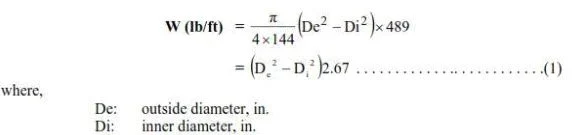
To calculate the weight is to determine the inner and outer diameter of the pipe using steel’s density (478 lb./cubic feet) and the following formula:
Casing Size and Drift Chart Abbreviations:
OD – Outside diameter
ID – Inside diameter
in – inch
lb/ft – pounds per feet
Nom.Wgt – Nominal Weight
Wall Thkns – Wall Thickness
Ensuring Proper Casing Clearances with Drift Specifications
Understanding drift diameter specifications is critical for preventing costly operational failures, stuck pipe incidents, and the inability to run completion equipment or downhole tools through cased wellbores. The charts above provide precise drift dimensions for all standard API casing sizes, enabling drilling engineers and completion designers to verify adequate clearance for drill bits, casing strings, production tubing, wireline tools, and artificial lift equipment that must pass through each casing section. Drift diameter represents the guaranteed minimum internal clearance after accounting for manufacturing tolerances, potential ovality, coupling restrictions, and thread protrusion—making it the controlling dimension for tool selection rather than the nominal inside diameter. Failure to properly account for drift diameter during well planning can result in equipment that physically cannot pass through the casing, requiring expensive fishing operations, sidetracking, or abandonment of wellbore sections. Running drift mandrels during casing inspection and before running casing verifies that each joint meets dimensional specifications and is free from dents, debris, or deformation that could restrict internal clearance.
Flowtech Energy provides casing that meets API 5CT drift diameter specifications and can supply certified drift mandrels for field inspection of casing prior to running. Our quality control processes include drift testing of used casing inventory to verify internal clearances meet API standards and are suitable for redeployment in new drilling operations. We understand that dimensional verification is essential for operators purchasing used casing, and we provide detailed inspection reports documenting drift testing results, wall thickness measurements, and thread condition assessments. Whether you’re sourcing casing for a new well program or evaluating used inventory for cost-effective alternatives, our technical team can assist with drift diameter analysis, tool clearance calculations, and verification that available casing meets your internal clearance requirements for planned drilling and completion operations. If you need assistance interpreting drift specifications, sourcing casing with verified dimensional compliance, or coordinating drift testing and inspection services, contact Flowtech Energy at 1-877-645-6693. We deliver comprehensive technical support and quality assurance for casing procurement—ensuring your wells are constructed with dimensionally compliant casing that provides reliable clearances for all planned downhole operations from drilling through production.
Join our international network of oilfield buyers & sellers! We respect your privacy as well as your time and that's why we only send our newsletter no more than TWICE A MONTH.
Two emails per month (maximum). No ads. No affiliate links.