
Tubing Size and Grade Chart
Tubing Importance
The oil and gas industry is a complex and capital intensive venture. It is also time consuming and involves multi-processes from drilling to casing and tubing.
Tubing proceeds to vertical drilling of a wellhole using a drill bit. This reaches the oil deposits deep under the ground. Tubing also follows casing where the wellhole is cemented in place. Once the casing is stabilized, tubing brings or transports gas or oil either vertically or horizontally from deep in the well to the surface. A little similar to casing, with 4.5 inches in diameter being the threshold, tubing is inserted into the production casing to complete the process.
Understanding Tubing Size and Grade Specifications
The oil and gas industry is a complex and capital intensive venture. It is also time consuming and involves multi-processes from drilling to casing and tubing.
Tubing proceeds to vertical drilling of a wellhole using a drill bit. This reaches the oil deposits deep under the ground. Tubing also follows casing where the wellhole is cemented in place. Once the casing is stabilized, tubing brings or transports gas or oil either vertically or horizontally from deep in the well to the surface. A little similar to casing, with 4.5 inches in diameter being the threshold, tubing is inserted into the production casing to complete the process.
Understanding tubing size and grade specifications is fundamental to designing efficient production systems that maximize flow rates while ensuring structural integrity under downhole pressures and temperatures. The tubing size and grade chart below provides comprehensive dimensional and material specifications for API-certified production tubing, including outside diameter (OD), wall thickness, nominal weight, and connection types such as external upset end (EUE) and non-upset configurations. Proper tubing selection requires analyzing wellbore geometry, anticipated production rates, fluid properties (including corrosivity and gas-oil ratios), artificial lift requirements, and pressure profiles from reservoir to surface. Selecting tubing that is too small restricts production capacity and limits artificial lift options, while oversized tubing increases costs unnecessarily and may complicate cement placement or reduce annular velocity for gas lift operations. These standardized specifications ensure compatibility with wellhead equipment, packers, subsurface safety valves, and artificial lift systems while meeting API 5CT manufacturing standards recognized worldwide for quality and performance in oil and gas production operations.
Tubing Size and Grade Chart
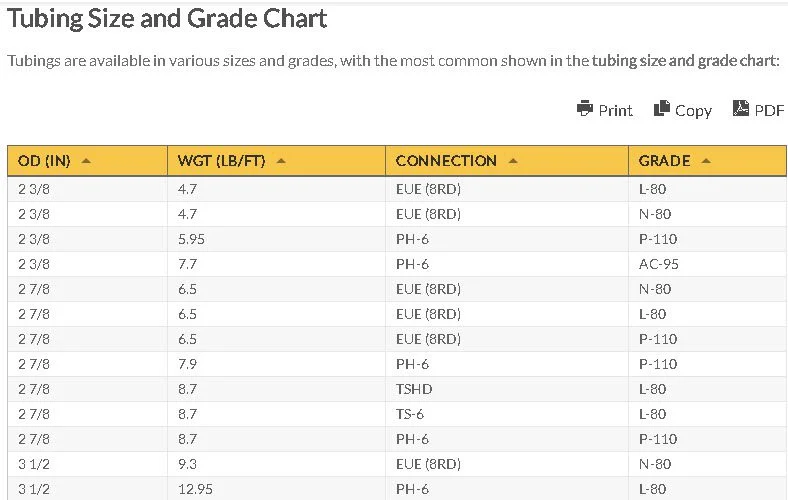
Tubings are available in various sizes and grades, with the most common shown in the tubing size and grade chart:
| wdt_ID | OD (in) | Wgt (lb/ft) | Connection | Grade |
|---|---|---|---|---|
| 1 | 2 3/8 | 4.7 | EUE (8RD) | L-80 |
| 2 | 2 3/8 | 4.7 | EUE (8RD) | N-80 |
| 3 | 2 3/8 | 5.95 | PH-6 | P-110 |
| 4 | 2 3/8 | 7.7 | PH-6 | AC-95 |
| 5 | 2 7/8 | 6.5 | EUE (8RD) | N-80 |
| 6 | 2 7/8 | 6.5 | EUE (8RD) | L-80 |
| 7 | 2 7/8 | 6.5 | EUE (8RD) | P-110 |
| 8 | 2 7/8 | 7.9 | PH-6 | P-110 |
| 9 | 2 7/8 | 8.7 | TSHD | L-80 |
| 10 | 2 7/8 | 8.7 | TS-6 | L-80 |
| 11 | 2 7/8 | 8.7 | PH-6 | P-110 |
| 12 | 3 1/2 | 9.3 | EUE (8RD) | N-80 |
| 13 | 3 1/2 | 12.95 | PH-6 | L-80 |
| 14 | 3 1/2 | 12.95 | BTS-6 | L-80 |
| 15 | 3 1/2 | 12.95 | PH-6 | P-110 |
| 16 | 3 1/2 | 15.8 | PH-6 | AC-95 |
| 17 | 3 1/2 | 15.8 | BTS-6 | T-95 |
| 18 | 3 1/2 | 15.8 | PH-6 | T-95 |
| 19 | 3 1/2 | 15.8 | TS-6 | C-95SS |
| 20 | 4 1/2 | 11.6 | LTC 8RD | P-110 |
| 21 | 4 1/2 | 15.5 | BTS-6 | L-80 |
| 22 | 4 1/2 | 15.5 | PH-6 | AC-95 |
| 23 | 4 1/2 | 15.5 | TS-6 | C-95SS |
| 24 | 4 1/2 | 15.5 | PH-6 | P-110 |
| 25 | 4 1/2 | 15.5 | BTS-6 | P-110 |
| 26 | 4 1/2 | 15.5 | TS-6 | P-110 |
| 27 | 4 1/2 | 17 | TSHD | Q-125 |
| 28 | 4 1/2 | 24 | PH-4 | C-95 |
| 29 | 4 1/2 | 24 | PH-4 | NT-95SS |
| 30 | 5 | 23.2 | HYDRIL CS | AC-95 |
| wdt_ID | OD (in) | Wgt (lb/ft) | Connection | Grade |
|---|---|---|---|---|
| 1 | 2 3/8 | 4.7 | EUE (8RD) | L-80 |
| 2 | 2 3/8 | 4.7 | EUE (8RD) | N-80 |
| 3 | 2 3/8 | 5.95 | PH-6 | P-110 |
| 4 | 2 3/8 | 7.7 | PH-6 | AC-95 |
| 5 | 2 7/8 | 6.5 | EUE (8RD) | N-80 |
| 6 | 2 7/8 | 6.5 | EUE (8RD) | L-80 |
| 7 | 2 7/8 | 6.5 | EUE (8RD) | P-110 |
| 8 | 2 7/8 | 7.9 | PH-6 | P-110 |
| 9 | 2 7/8 | 8.7 | TSHD | L-80 |
| 10 | 2 7/8 | 8.7 | TS-6 | L-80 |
| 11 | 2 7/8 | 8.7 | PH-6 | P-110 |
| 12 | 3 1/2 | 9.3 | EUE (8RD) | N-80 |
| 13 | 3 1/2 | 12.95 | PH-6 | L-80 |
| 14 | 3 1/2 | 12.95 | BTS-6 | L-80 |
| 15 | 3 1/2 | 12.95 | PH-6 | P-110 |
| 16 | 3 1/2 | 15.8 | PH-6 | AC-95 |
| 17 | 3 1/2 | 15.8 | BTS-6 | T-95 |
| 18 | 3 1/2 | 15.8 | PH-6 | T-95 |
| 19 | 3 1/2 | 15.8 | TS-6 | C-95SS |
| 20 | 4 1/2 | 11.6 | LTC 8RD | P-110 |
| 21 | 4 1/2 | 15.5 | BTS-6 | L-80 |
| 22 | 4 1/2 | 15.5 | PH-6 | AC-95 |
| 23 | 4 1/2 | 15.5 | TS-6 | C-95SS |
| 24 | 4 1/2 | 15.5 | PH-6 | P-110 |
| 25 | 4 1/2 | 15.5 | BTS-6 | P-110 |
| 26 | 4 1/2 | 15.5 | TS-6 | P-110 |
| 27 | 4 1/2 | 17 | TSHD | Q-125 |
| 28 | 4 1/2 | 24 | PH-4 | C-95 |
| 29 | 4 1/2 | 24 | PH-4 | NT-95SS |
| 30 | 5 | 23.2 | HYDRIL CS | AC-95 |
For tubing, the most important dimensions are its outside diameter (OD) and wall thickness (WT), as these measurements express the true dimensional value of this hollow metal. OD’s precise measure will indicate the maximum weight the tubing can withstand. Both OD and WT are expressed in inches or millimeters. Other key measurements consist of mechanical properties like tensile strength, yield, and elongation.
Tubing Size and Grade Chart Abbreviations:
- in – inches
- lb/ft – pounds per feet
- EUE – External Upset End
- TSHD – Trailing Suction Hopper Dredger
- LT – Linear Time
- OD – Outer Diameter
- WGT – Weight
Tubing Types
Tubing can be customized to specific operating conditions. Commonly used tubing types include the following:
- H-40 type is an economical option designed for shallow wells.
- J-55 is the most common tubing used for medium depth wells which can be up to 7,000 ft deep.
- C-75 is the improved version of J-55; It is used in wells with similar depths, but is not common.
- N-80 is a pipe designed for 12,000 ft or more in depth wells.
- P-105 is a heavy duty pipe intended for use in high-gas pressure formations or for deep wells.
Tubing Options
Tubing is basically a seamless pipe, sold at irregular lengths ranging from 28 to 40 ft. A tubing string is put together by selecting and putting together an appropriate mix of lengths of tubing joints. Joints are available from 2 to 12 ft long with a 2 ft step increment for each size. Tubings are made with different wall thickness and several metal quality: mild steel, stainless steel, brass, copper, chrome, and aluminum which affect the costs. These make them costlier than pipe.
Tubing Specifications
Tubes are manufactured under strict specifications and must be tested for tensile strength and hardness. Steel tubings used in high pressure condition come in short OD (up to 5 inches), while tubulars that are used for mechanical application are available in higher length diameters.
Sourcing Quality Tubing for Optimal Well Performance
Selecting the right combination of tubing size, grade, and connection type is critical for maximizing well productivity, minimizing operating costs, and ensuring long-term production system reliability. The charts above provide detailed specifications across the full range of API tubing sizes from 1.050 inches through 4.500 inches and grades from economical H-40 for shallow wells to premium P-105 for deep high-pressure applications. Understanding the relationship between tubing metallurgy, wall thickness, and downhole conditions helps production engineers optimize completion designs for specific reservoir characteristics and fluid properties. Factors including corrosion resistance requirements, collapse and burst pressure ratings, tensile strength for deep wells, and drift diameter for wireline access all influence tubing specification decisions that impact both initial completion costs and lifecycle operating expenses.
Flowtech Energy maintains comprehensive inventory of API 5CT certified production tubing in seamless construction with various wall thicknesses, grades, and connection options to meet diverse production requirements. Our tubing inventory includes standard carbon steel grades for conventional sweet oil and gas production, corrosion-resistant alloys for sour service and CO2 environments, and specialty metallurgies for thermal recovery and high-temperature applications. We supply both new premium tubing and thoroughly inspected used tubing that offers cost-effective alternatives for operators seeking to reduce completion costs while maintaining quality and performance standards. Each tubing joint is available with complete material certifications documenting chemical composition, mechanical properties, dimensional specifications, and hydrostatic test results required for regulatory compliance and operator quality assurance programs. Our technical team provides engineering support to help optimize tubing selection based on nodal analysis, pressure drop calculations, corrosion risk assessment, and artificial lift system compatibility. Whether you’re completing new wells, performing tubing replacements during workovers, or planning field-wide tubing upgrades to accommodate production optimization initiatives, we deliver expert guidance on material selection, connection types, and procurement strategies that balance performance requirements with project economics. If you need assistance selecting appropriate tubing sizes and grades for your production conditions, sourcing certified materials with complete traceability and documentation, or coordinating delivery and field support for completion operations, contact Flowtech Energy at 1-877-645-6693. We provide comprehensive tubing procurement solutions—from specification review through final delivery—ensuring your wells are equipped with properly sized and graded tubing that delivers optimal production performance, operational reliability, and long-term value throughout the productive life of your assets.
Go here if you are looking for the Tubing Grade and Connection Type Chart.